
Steel detailing pricing guide for fabricators
How Much Does Structural Steel Detailing Really Cost?
A price per ton tells you what the detailing company charges. It does not tell you what the detailing will ultimately cost your fabrication shop.
Pricing depends on tonnage, complexity, connections, miscellaneous metals, schedule, revisions, deliverables, and project risk. The lowest quote can become the most expensive option when poor coordination leads to rework, missed releases, incorrect CNC files, or field modifications.
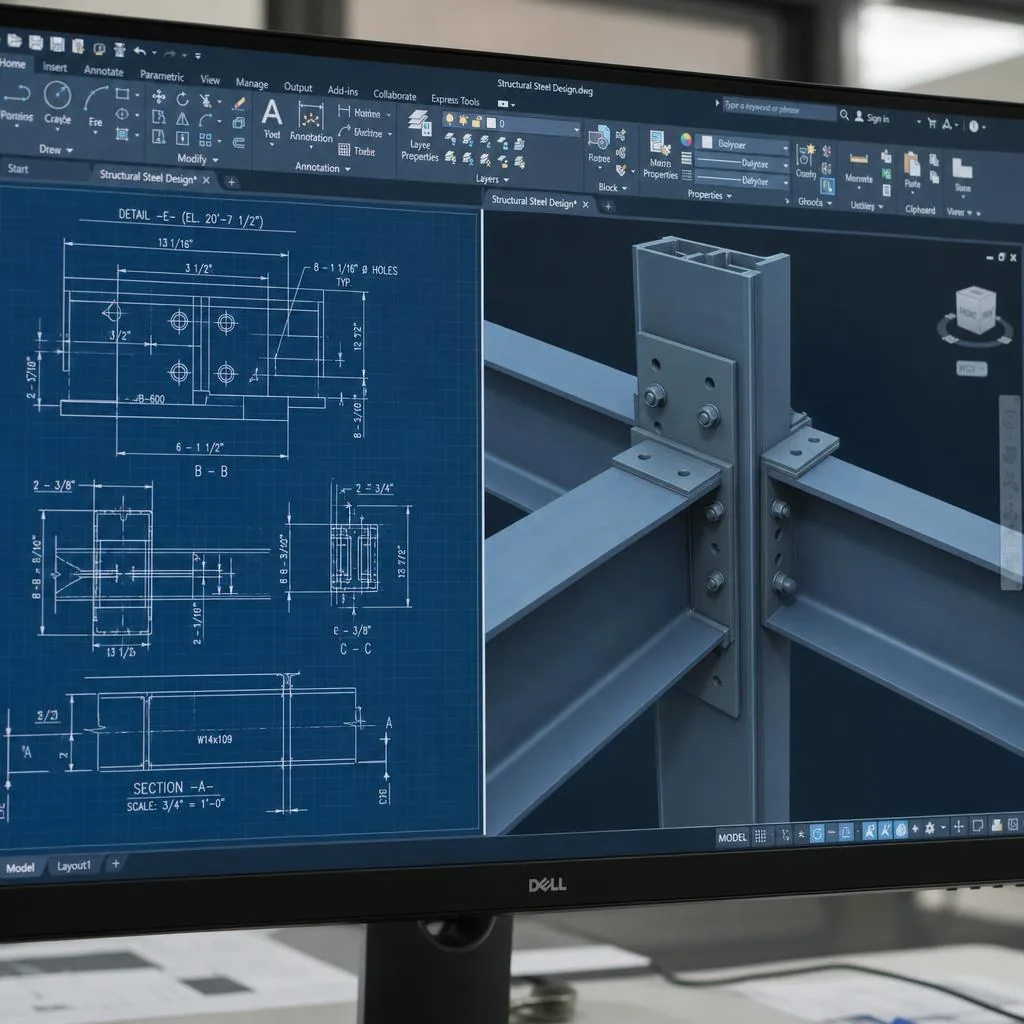
Fabricator-first pricing
Look beyond the invoice.
The short answer
How Much Does Structural Steel Detailing Cost?
There is no universal structural steel detailing price because two projects with the same tonnage can require dramatically different amounts of detailing work.
Steel detailing may be quoted per ton, hourly, per drawing, per piece, as a fixed project fee, or by sequence or package. Tonnage alone does not determine detailing effort. Connection density, unique members, miscellaneous steel, BIM coordination, CNC requirements, revisions, approvals, field verification, and schedule all matter.
What changes the number
Why Does Steel Detailing Pricing Vary So Much?
The right cost comparison starts with the work required to make a package fabrication-ready—not just the weight of the steel.
Tonnage
Tonnage matters, but it is only the beginning. A repetitive 500-ton warehouse can require less effort than a smaller project with complex connections.
Connection complexity
Simple shear connections are fundamentally different from moment connections, seismic systems, complex bracing, and specialty requirements.
Number of pieces
Many small, unique members can generate substantially more work than a heavier project made up of repetitive framing.
Miscellaneous steel
Stairs, rails, ladders, platforms, embeds, and miscellaneous metals can require significant detailing effort relative to their tonnage.
Schedule
Accelerated release sequences and compressed fabrication schedules require additional planning and production capacity.
Revision exposure
Incomplete design information and repeated changes can increase detailing effort, coordination time, and project risk.
Total shop cost
The Cheapest Detailing Quote May Be the Most Expensive Detailing Decision.
The detailing invoice is not necessarily the largest financial risk. A detailing failure can create costs far beyond the original detailing fee.
01
Shop rework
Incorrect or outdated information may require fabricated steel to be modified or replaced.
02
Lost production time
The fabrication line can slow or stop while the shop waits for corrected drawings.
03
Material waste
Incorrect pieces, hole locations, connections, or dimensions can create scrap and rework.
04
Field modification
Problems discovered during erection are considerably more expensive to correct than problems found in the model.
05
Schedule disruption
Late releases can affect fabrication, shipping, erection sequencing, and downstream trades.
06
Management time
Estimator, PM, superintendent, and shop personnel time spent managing a detailer has a cost.
Your detailing cost is not the invoice.
It is the invoice plus everything the drawings cause afterward.
Benchmark with care
Price Per Ton: Useful Benchmark or Dangerous Shortcut?
Price per ton can be useful for relatively repetitive structural steel projects, but it can be misleading when project complexity varies significantly.
Two projects can each contain 400 tons. One may have repetitive framing and standard connections. The other may have moment connections, multiple elevations, miscellaneous metals, tight tolerances, heavy coordination, and several release sequences. The tonnage may be identical. The detailing workload is not.
Project A
- Repetitive framing
- Standard connections
- Few revisions
- Straightforward sequencing
Project B
- Complex moment connections
- Multiple elevations
- Miscellaneous metals
- Heavy coordination
- Multiple release sequences
Compare the whole proposal
How Should Fabricators Compare Steel Detailing Quotes?
Do not compare only price. Compare the scope, accountability, deliverables, and process that sit behind the price.
What should a structural steel detailing quote include?
A complete proposal makes assumptions visible before work begins: scope, drawings, model delivery, CNC/DSTV files, RFI and revision processes, release plan, schedule, exclusions, and coordination responsibilities.
Have Tectonix Review Your ProjectTectonix perspective
Tectonix Does Not Treat Detailing as a Drawing Commodity.
Good project management costs money. Poor project management costs more. Tectonix connects U.S.-based project leadership, named PM ownership, Tekla Structures, fabrication-ready drawings, QA/QC, RFI management, revision control, constructability review, and release sequencing directly to the total cost of the job.
Stop Paying Your People to Manage Your Detailer.
Your estimator, project manager, shop superintendent, and operations team already have jobs. They should not need to repeatedly chase drawing status, missing RFIs, revision questions, release dates, approval comments, model issues, or fabrication questions.
See How Tectonix Manages ProjectsDelivery model
Domestic vs. Hybrid Steel Detailing: What Are You Actually Comparing?
A hybrid delivery model can provide scalable production capacity while retaining U.S.-based management, communication, technical oversight, and quality control. The right structure depends on the project requirements.
Contract, security, government, institutional, client, or specification requirements may call for fully domestic execution. Tectonix evaluates the appropriate delivery structure during project review.
Why Tectonix Is DifferentWhen quality earns its place
When Is It Worth Paying More for Steel Detailing?
Potentially when the project carries substantial schedule, fabrication, or coordination risk: accelerated schedules, complex connections, tight tolerances, difficult erection sequencing, major revision exposure, BIM coordination, or high field-modification risk.
The more expensive the mistake, the more important the detailing process becomes.
Illustrative calculator
What Could a Detailing Failure Cost Your Shop?
Enter any optional values below. The calculator illustrates downstream exposure; it does not estimate Tectonix pricing or predict the outcome of a project.
Illustrative planning tool
This is not a project estimate or guarantee. It helps show how quickly the downstream cost of a detailing problem can add up.
Estimated detailing failure cost
—
Enter any optional values to see an illustrative total.
Fabricator answers
Structural Steel Detailing Cost FAQ
Direct answers to the questions behind a detailing quote.
There is no universal price because two projects with the same tonnage can require dramatically different amounts of detailing work. Pricing depends on tonnage, complexity, connections, deliverables, schedule, revisions, and project requirements.
Steel detailing may be quoted per ton, hourly, per drawing, per piece, as a fixed project fee, or by sequence or package. The appropriate method depends on the scope and risk of the project.
Per-ton pricing is used as an industry benchmark, but it should not be treated as universally appropriate. Complexity per ton, unique pieces, connections, coordination, and deliverables can vary substantially.
Some work may be priced hourly, while other projects use fixed, per-ton, per-piece, per-sheet, or package pricing. Ask the detailer to explain what the chosen method includes and excludes.
Differences may involve labor structure, geographic location, scope, project management, deliverables, QA/QC, revision assumptions, and what is excluded from the proposal. A lower invoice is not automatically a lower total project cost.
It depends on internal capacity, staffing utilization, project volume, schedule requirements, and the complete scope being compared. Compare the total delivery model, not only the line item.
A complete proposal should describe scope, modeling requirements, drawings, bills of material, CNC/DSTV files where required, connection coordination, RFI and revision processes, release plan, schedule, assumptions, exclusions, and delivery format.
The software is only part of the equation. Project complexity, coordination requirements, modeling standards, and deliverables determine the overall workload.
Timelines vary with project size, complexity, RFI response, approval cycles, and release strategy. A responsible detailer should review the actual package before committing to a schedule.
The cost can appear as rework, downtime, material waste, schedule disruption, field modifications, and management time spent chasing drawings, RFIs, revisions, and release dates.
Provide the structural drawings, specifications, connection information, scope requirements, schedule, and required deliverables. A project review is more useful than a tonnage-only guess.
Don’t Ask Only What Detailing Costs.
Ask What the Detailing Process Could Cost Your Shop If It Goes Wrong.
Send Tectonix your project package. We can review scope, tonnage, complexity, deliverables, schedule, release strategy, and project risks before providing an appropriate proposal.